
The Problem
Explaining why race should be removed from—or only used with careful consideration in—clinical algorithms is both nuanced and scientifically complex. Yet scientists must be able to communicate this clearly and compellingly not only to experts, but also to patients, neighbors, policymakers, journalists, and physicians outside their specialty. Too often, these conversations become mired in technical details instead of focusing on the people whose care is directly affected, which can result in limiting understanding, trust, and adoption.
Medical societies can accelerate progress by equipping members with practical communication tools that translate complex evidence into patient-centered stories. By making communication a core part of implementation—not an afterthought—societies can help ensure that advances in evidence-based medicine are understood, adopted, and trusted by clinicians and the communities they serve.
The Approach
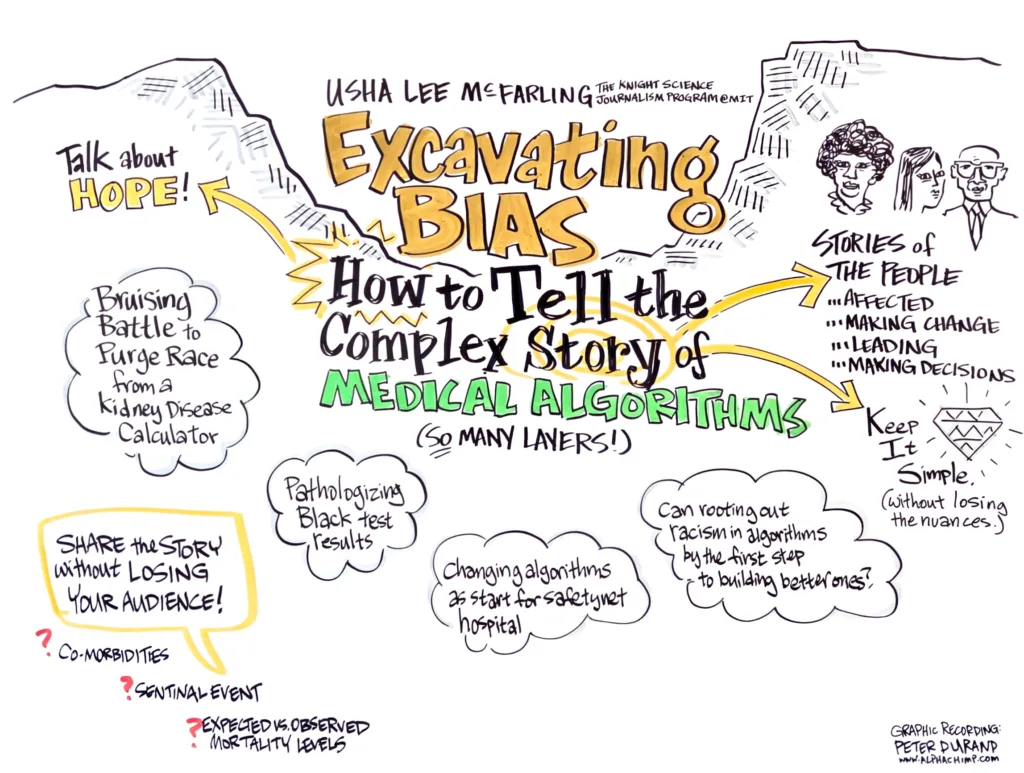
Award-winning science journalist Usha Lee McFarling argues that effective communication begins with people, not algorithms. Rather than leading with medical jargon, clinicians should tell stories that illustrate how clinical decisions affect real patients, how race-based algorithms reflect broader historical trends, and how the object of this work is to improve accuracy and health outcomes.
Lead with Personal Stories
Instead of leading with glomerular filtration rates, physicians can tell the stories of patients such as Jazmin Evans, a young woman whose kidney disease severity was underestimated because race was inappropriately factored into her test results, resulting in low prioritization on kidney transplant lists. After the race-based calculation was removed, her waitlist time was shortened, and she ultimately received a life-saving kidney transplant.
Lead with History
The inclusion of race in lung function tests reflects long-discredited beliefs that Black people inherently had smaller lung capacity—a claim that dates back to Thomas Jefferson’s Notes on the State of Virginia and was absorbed by researchers who developed spirometers to measure lung function in the mid-19th century. The legacy of racism persists in some clinical calculations that appear objective but are rooted in disproven assumptions.
Lead with Accuracy
A healthy 20-year-old woman was told that a routine blood test showed she might have leukemia because her white blood cell count was low. She spent weeks believing she had cancer before learning that her blood count was actually normal for someone with her ancestry. Her experience shows how reference ranges based primarily on white populations can lead to unnecessary anxiety, additional testing, and delayed reassurance. The goal is accuracy, not the removal of race in all equations.
Dos and Don’ts for Communicating with General Audiences
Do
- Use plain language
- Center patients’ experiences
- Use human details to make the stories relatable
- Tell the story of the physicians, patients, and medical students driving this change
- Tie in the broader story about the history of race in America
- Practice explaining these concepts to people outside the medical community
Don’t
- Don’t use jargon
- Don’t talk about algorithms without mentioning the people who are affected by them
Call to Action
In the course of your work, if you come across compelling patient stories that you are able to share, please send them to encodingequity@cmss.org so that we may share them with our community.