

The Challenge
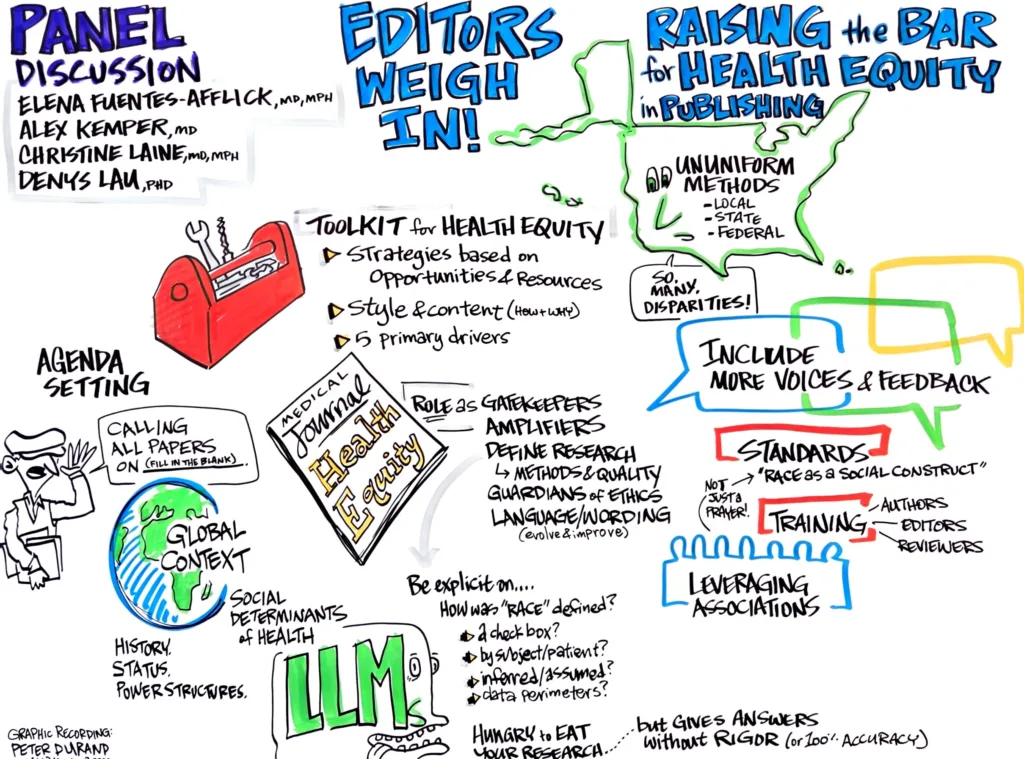
Medical journals occupy a critical space in the health research ecosystem. They have a responsibility to not only set the bar for what constitutes sound science but also to minimize the potential for harm. This poses a unique challenge: How can editors document the effects of race and ethnicity on health without reinforcing the false notion that race is a biological construct?
The Role of Journals
Journals carry out a variety of functions that, if applied strategically, can help reinforce accurate, equitable practices. Journals are:
- Gatekeepers: Editorial decisions influence which questions, methods, and findings are worthy of publication. Journals can require authors to justify how race and ethnicity, among other factors, are defined and used, strengthen analyses before publication, or reject studies that rely on flawed assumptions.
- Amplifiers: Through social media, email, podcasts, and more, journals decide which research reaches the widest audience. Giving health equity work the same visibility as major clinical trials can help elevate its importance across the field.
- Guardians: Editorial standards and language shape how clinicians, policymakers, and the public understand health disparities. Thoughtful framing and respectful, person-centered terminology help ensure research reflects social realities rather than reinforcing harmful assumptions.
The Approach
To avoid perpetuating the incorrect use of race as a proxy for structural inequalities, journals can do more than simply requiring authors to state that race is a social construct. Journals should provide clear guidelines and processes for how authors collect and analyze data containing race as a variable.
“Everything starts with the data collection”, says Denys Lau, Editor-in-Chief of the American Journal of Public Health. “If your data are not collected the right way, then it doesn’t matter what you do statistically.”
For legacy datasets where race has already been incorporated into analyses, authors should clearly explain how race was used and discuss its implications in the findings and discussion, not just in the limitations section. International research should also acknowledge that racial and ethnic categories vary across countries and cultures, making context essential to interpretation.
Lessons Learned
- Start with the most feasible changes rather than attempting a complete overhaul. For example, if authors use legacy datasets, require acknowledgement in the introduction, not just the limitations section.
- Strengthen methodological transparency by requiring authors to explain how race and ethnicity were defined, measured, and analyzed.
- Review legacy datasets carefully and encourage authors to discuss the implications of race-based analyses in the findings and discussion—not just the limitations.
- Provide reviewers with guidance on evaluating the appropriate use of race and ethnicity in research. Direct them to the NASEM Report: Rethinking Race & Ethnicity in Biomedical Research and key literature.
- Collaborate with peer journals and share lessons learned to promote consistent standards across the field.
- Don’t try to implement every recommendation at once.
- Don’t reject studies simply because they include race or ethnicity; instead, ensure these variables are scientifically justified and interpreted appropriately.
- Don’t assume racial and ethnic categories are universal. They vary across countries, cultures, and contexts.
- Don’t publish papers that treat race as a proxy for societal factors.
Call to Action for Medical Journals
- To begin, adopt an existing reporting standard, such as the ICMJE (International Committee of Medical Journal Editors) recommendations or the guidance published by JAMA.
- Use the Encoding Equity Medical Journals Implementation Toolkit to identify practical, resource-appropriate strategies for your journal.
- Join the broader community of editors, reviewers, and publishers working to strengthen the responsible use of race and ethnicity in medical research.